VIA Verona 2026 Supporter Masterclass: Consorzio Tutela Vini Collio
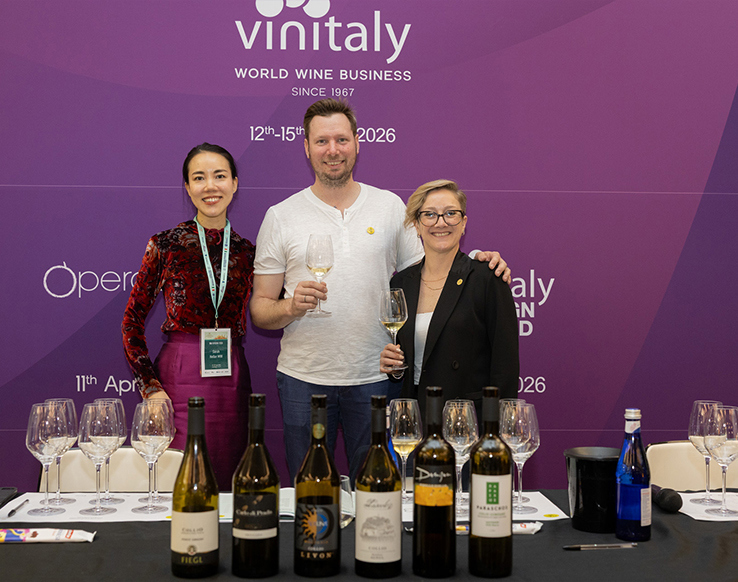
Discovering Collio
The Consorzio Tutela Vini Collio was the second Supporter Masterclass on Day 1 of VIA. Luca Raccaro, President of the Consorzio, gave the introduction and explained that the soul and style of life in the Collio region of Friuli Venezia Giulia is defined by the blend of cultures that comes from being a borderland and a crossroads of Latin, Slavic, and Germanic people. Collio is in the far eastern corner of the region, in the province of Gorizia. The Collio Consorzio was the third consortium created in Italy, in 1964, and received its DOC in 1968. The region currently has 288 wineries and produces 7 million bottles per year. Lavinia Zamaro, Director of the Consorzio added that Collio is distinct from the area known as Colli Orientali, with different grapes, vineyard locations, and wines. Collio's focus is specifically on white wines, which make up 88% of their production.
Luca explained the climate in Collio, with its hot summer, rainy spring and autumn, dry cold winter, and not much snow. The area is known for high quality grapes due to concentration from the hot summer, and producers are aware of the risk of high alcohol. The wines are especially known for structure and balance. The area is rich in ponca soil (an archetypal Flysch soil), unique to this region, which has a stratified sandstone and marl layering, and is very rich in minerals. Roots of the vines can go deep, and the soil is well drained.
The Collio grape cultivation is:
Pinot Grigio 25%
Sauvignon Blanc 17%
Friulano 15%
Ribolla Gialla 12%
Malvasia Istriana 3.5%
Picolit, Traminer, Riesling, Müller Thurgau are also present in small amounts
Collio Bianco is the flagship wine of the denomination. It is a blend (cuvée), and considered the true essence of Collio. Each producer can choose their own blend, using the specific grapes of the regions. A new bottle was designed for the Collio in 2009, with a distinctive yellow capsule and the Collio logo stamped on the top. Yellow was chosen as the color for the denomination due to the importance of their white wines. The new bottle is low weight at 500g of glass, with a distinctive shape, and using a high quality cork. The region is certified SQNPI (Sistema Qualità Nazionale di Produzione Integrata), an Italian national sustainability certification aimed at enhancing agricultural products produced using low-environmental-impact farming techniques. The region uses minimal chemicals, and has deep respect for ecology and the environment. The Collio Consorzio became the head of the group in 2021 with the intention to grow the number of certified vineyards across Italy.
Sarah admired Collio as always having been a focus of aspirational blends of white grapes. Luca explained the region is a C shape, or a half moon, on the border with Slovenia. Looking at the map, the left part is the coldest, the middle is hottest, and the right part is the highest in altitude. There is a strong modern movement towards the production of clean, gentle press, high quality white wines. Recently, more aromatic, perfumed, tropical, exotic styles have emerged. The wines are never exaggerated, generally softer in acidity than other native Italian whites, with a distinctive waxy, oily texture that adds balanced volume on the palate.
Fiegl Collio DOC Pinot Grigio 2025 is a beautifully clean, precise, moderate acidity, moderate body weight and lovely textural finish.
Carlo di Pradis Collio DOC Friulano 2023 has body, density, 13/% abv, batonnage on lees adds to the texture. Luca said "This is the wine of our heart, made with 100% Friulano grapes. Every producer has this wine in their portfolio, and it can age very well, becoming bolder over time".
Livon Collio DOC Malvasia "Soluna" 2023, made with Malvasia Istriana grapes, which have an historical connection with Greece, where they came from an island with only one port ("monem vasia"). Over time, Malvasia became a “brand” name, and there is not a lot of consistency across Malvasias, especially since they are a group, not a genetically related family of grapes. Malvasia Istriana is driven by a saline quality that evolves into a petrocor, kerosene, Riesling style in age. These grapes dry gently on the vine, but maintain high acidity. There was a small amount of barrique aging for 20% before assemblage and 8 mos aging in bottle. This is a wine with upright acidity, oily texture, a beautiful example of a wine of tension. Luca says they consider it autochthonous even though it is not necessarily a native grape, but has been cultivated in Collio for several hundred years. The salinity, structure, and body support the high acidity of the wine, this is why Collio is unique.
Pascolo, Collio DOC Bianco "Agnul" 2021 is a Collio Bianco blend, Sauvignon Blanc, Friulano, Pinot Bianco. There are three micro climates in Collio, this wine is from the coldest part of the Collio. The current winemaking preference is for concrete or steel, or very large old oak barrels, to maintain and improve the aromatic character. Most of the wines are not released immediately, they are aged before and after bottling. Lots of batonage on lees is typical and most are blended 6 months before bottling
Damijan Podversic, Collio DOC Ribolla Gialla 2021 is a particular style (Sarah says they are amber or orange, depending on your viewpoint). The producer is an acolyte of Jasko Gravner, using long maceration of Ribolla Gialla, inspired by Georgian amphora wines. Collio specialises in macerating white wines – it is not a fashion,it is truly part of their history. They used maceration in Collio to start the fermentation before technology evolved. After the advent of technology, people were in favor of clean wine. Now, there is a return to the historic maceration to develop the phenolic compounds of the grape. Ribolla Gialla suits this style, with a full body and high acidity. This wine was macerated for 90 days. Friuli kicked off the orange wine phenomenon and was very misunderstood. This is not oxidated, not volatile, there is a very high level of texture, with a rounded, pebbly quality, not gritty or sandy. This is not made in amphora.
Luca points out that, currently, amphora is "not our business", the ones who use it are outside the Collio DOC. The macerated wines of Collio are created in large oak barrels or concrete tanks, encouraging phenolic development. Ribolla Gialla has good acidity that allows it to support the development of the body. This is not part of the “natural” wine movement. The maceration is not used to cover something, but to create a savory, umami, textural style. Long contact with skins and yeasts are the keys.
Paraschos, Collio Goriziano DOC Sauvignon Blanc Riserva 2022. Not a thiol driven wine, not trying to get the typical aromatics. Fermented in a large oak barrel and 24 months in large oak on fine lees, whole bunch press, golden color. Reductive quality, golden toned fruit, cider apple, quince, sulphur character, flinty graphite on the palate, mineral contrast to the ripe fruit, much lower acidity than expected. Not a typical Sauvignon Blanc, but a traditional style for Collio.
Luca asserts that "in Collio, we want to be unique. We want people to come to us to taste the wines. We believe Ribolla Gialla should be made as a macerated wine because of the tradition and the ability to draw out the true character of the grape. We want to move away from the clear, light, clean low alcohol Ribolla Gialla style that became popular in recent years, and return to our traditions. Our Pinot Grigio and Sauvignon Blanc are traditional for us because they are totally different from other international styles and we want to keep this unique aspect of our wine making".
Lavinia added that, "Our vineyards are the gardens of our households. Respecting the environment and working in the SQNPI regulations is very hard, but the philosophy is to leave the territory better for future generations".
Sarah asked how to distinguish Collio from Colli Orientali and Lavinia was happy to explain that “Collio has a different history, we were ruled by another empire for hundreds of years, the point of view is a little different. We are relatives but we are distinct territories. We collaborate with Orientali but the identity is different, they have lots more red autochthonous grapes. The exposition and higher altitude of our hills is significant. In Collio, all the vineyards must be planted on slopes, Orientali has large areas of flatland vineyards (still good quality but style is not the same).” Sarah commented that the most commercially successful styles right now are still the unmacerated styles. Luca added that Friulano is the variety that can really acclimatise itself best to all parts of the region, and it best expresses the territory. Collio has no autochthonous red grapes, but the most expressive red in Collio is Merlot and it is considered traditional, not a contemporary addition, due to its presence in the region for over 200 years.
Wines tasted:
1. FIEGL: Collio Doc Pinot Grigio 2025
2. CARLO DI PRADIS: Collio Doc Friulano 2023
3. LIVON: Collio Doc Malvasia "Soluna" 2023
4. PASCOLO: Collio Doc Bianco "Agnul" 2021
5. DAMIJAN PODVERSIC: Collio Doc Ribolla Gialla 2021
6. PARASCHOS: Collio Goriziano Doc Sauvignon Riserva 2022