Erbaluce di Caluso heading towards a new era as production, values and the market are growing
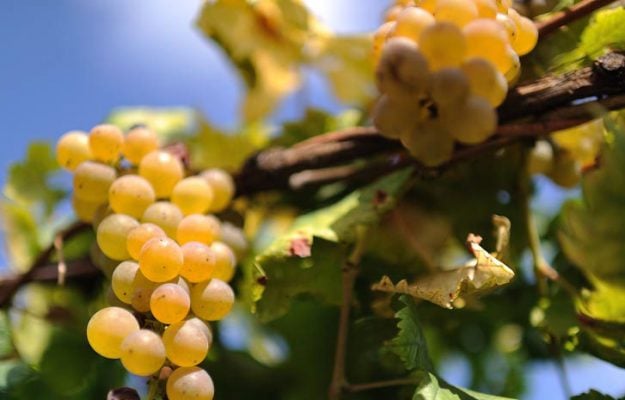
It is a fact that more or less 20 major Italian wine denominations out of over 500 total, including PDO and PGI – counting on the strength of their history and numbers, are capable of investing and opening markets - alone represent more than half of the turnover of the sector. It is equally undeniable that much of the charm of Italian wine, especially among the most experienced wine lovers, is the myriad of small denominations that although small in size, are capable of narrating stories, identities and territories. These companies often experience fluctuating phases of growth or regression over the years, but in their own way embellish the Italian wine offer.
For instance, in the Canavese area in Piedmont, Erbaluce di Caluso DOCG. It is the fruit of a grape variety, Erbaluce, about which the first written records date back to the Seventeenth century, mentioned in a book by Giovan Battista Croce, jeweler of Duke Carlo Emanuele I. According to tradition, its name, Erbaluce, originated from the color that the berries take on in autumn. However, there is also a version linked to a legend. The legend narrates that the lands in the Canavese area were once inhabited by nymphs and gods, and two of them, the Dawn and the Sun, were in love, but destined not to be able to meet. However, an eclipse of the Moon permitted them a fleeting encounter from which the nymph Albaluce was born. The nymph was so beautiful that she convinced man to give her everything in order to receive her favors, to the point of turning those hills into a desert. Full of sorrow, Albaluce wept and from her tears sprouted vine shoots from sweet and white grapes: Erbaluce.
Apart from traditions and legends, today this small and historic denomination (DOC of Piedmont white wines since 1967, and DOCG since 2010), tells the story of a rebirth that represents the revival of many small territories. In 2000, there were just 128 declared vineyards in Erbaluce di Caluso DOCG, while in 2020 there were 227, growing + 77% in 20 years. Grape producers have remained roughly the same - 281 in 2000, 288 in 2002 (following a peak of 333 in 2009, ed.). The supply chain is made up of 39 winemakers and 35 bottlers, while grape production has grown significantly (from 10.380 quintals in 2000 to 16.520 in 2020), and also the number of potential bottles (from 968.800 to more than 1.5 million), with an estimated bottled value worth 10 million euros.
These numbers (presented recently on Erbaluce Day, an event created by Cascine Piemontesi-Confagricoltura, Confagricoltura Turin and the Consorzio Vini DOCG di Caluso and DOC di Carema and Canavese), narrate the recovery of the territory, which took place in a unusual way, as Ercole Zuccaro, director of Confagricoltura Piemonte explained to WineNews. “There are only a few historic companies that have been able to hold out, but have always believed in this wine and in this territory. Cooperatives have strengthened, and have consolidated their presence on the markets, starting from a significant improvement in quality. And further, there is a group of young Canavese winemakers”, Zuccaro explained, “who have rediscovered this vine, are reviving the vineyards, and are doing so respecting the territory, the environment and the landscape, maintaining some of the most important conditions, like, for instance, the recovery of dry stone walls”. Moreover, Zuccaro added, the area where Erbaluce di Caluso is produced, “is an interesting area from a touristic point of view as well. The beauty of this large Moraine hill that forms a natural amphitheater, plus the area of the "Five Lakes" in Ivrea and two other lakes, Viverone and Candia, attracts abundant summer tourism, even from abroad. And above all, thanks to younger companies, wine tourism is developing, and becoming an increasingly important resource”. At the basis of the renaissance of Erbaluce, however, there is also, or above all, an enological recovery. “There has been excellent improvement on the still type wines, as well as on the Passito, which is perhaps the most famous wine. For several years now, though”, Zuccaro continued, “the classic method sparkling wine that comes from Erbaluce has also been enjoying great success. Almost all the companies make products that are refined at least 24 months on the yeasts, but they often reach 36 months, giving life to more and more interesting and recognizable products”.
Consequently, the Erbaluce market is experiencing a positive phase, as sales are growing in Piedmont, Lombardy and Liguria, and there are interesting export openings, especially in the US and Northern Europe. “And another interesting thing”, Zuccaro concluded, “is that some land value is being recovered. Obviously, we are far from the values of other Piedmont and Italian territories, but we can say that the range is between 28.000 and 40.000 euros per hectare. These are indeed attractive values for those who want to do business, and recently there have been many entrepreneurs from other sectors who have invested in Erbaluce di Caluso, reviving companies, as well as producers from other territories, especially from Alba and the Langhe who are showing growing interest”. They are starting to set their sights on this small, historic territory, which, like many other small Piedmont wine gems, from Gattinara to Timorasso, for example, are experiencing a new era.