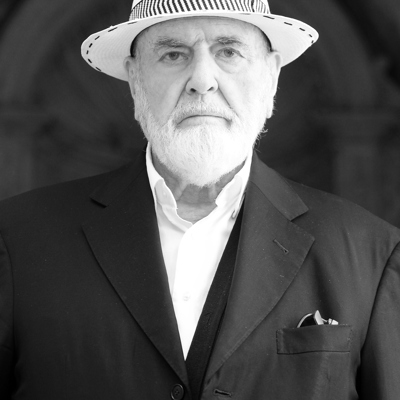
MICHELANGELO PISTOLETTO
(Honorary President of the Jury)
Michelangelo Pistoletto was born in Biella in 1933.
He began exhibiting in 1955, and in 1960 he held his first solo show at the Galleria Galatea in Turin. His early pictorial production was characterized by a focus on self-portraiture.
In the years 1961–1962 he created the Mirror Paintings, which directly include the presence of the viewer within the work and introduce the real dimension of time; they also reopen perspective, overturning the Renaissance model that had been closed off by the avant-gardes of the twentieth century. With these works Pistoletto quickly achieved international recognition and success, leading him, already during the 1960s, to hold solo exhibitions in prestigious galleries and museums in Europe and the United States. The Mirror Paintings would become the foundation of his subsequent artistic production and theoretical reflection.
Between 1965 and 1966 he produced a group of works entitled Minus Objects, considered fundamental to the birth of Arte Povera, an artistic movement of which Pistoletto is a driving force and leading figure. Beginning in 1967, he created actions outside traditional exhibition spaces that represented the first manifestations of the “creative collaboration” Pistoletto would develop over the following decades, bringing together artists from different disciplines and increasingly broad sectors of society. Between 1975 and 1976, he created at the Stein Gallery in Turin a cycle of twelve consecutive exhibitions, Le Stanze (The Rooms), the first in a series of complex works developed over the span of a year, called “continents of time,” such as Anno Bianco (White Year, 1989) and Tartaruga Felice (Happy Turtle, 1992).
In 1978 he held an exhibition in which he presented two fundamental directions of his future research and artistic production: Division and Multiplication of the Mirror and Art Takes on Religion.
At the beginning of the 1980s he created a series of sculptures in rigid polyurethane, later translated into marble for his 1984 solo show at the Forte di Belvedere in Florence. From 1985 to 1989 he created the series of “dark” volumes known as Art of Squalor.
During the 1990s, with Progetto Arte and with the creation in Biella of Cittadellarte–Fondazione Pistoletto and the University of Ideas, he placed art in active relation with different areas of the social fabric, aiming to inspire and produce responsible transformation of society. In 2003 he was awarded the Golden Lion for Lifetime Achievement at the Venice Biennale.
In 2004 the University of Turin awarded him an honorary degree in Political Science. On that occasion the artist announced what would become the most recent phase of his work, known as the Third Paradise.
In 2007 he received in Jerusalem the Wolf Foundation Prize in Arts, “for his consistently creative career as an artist, educator, and initiator, whose tireless intelligence has given rise to visionary forms of art that contribute to a new understanding of the world.”
In 2010 he authored the essay The Third Paradise, published in Italian, English, French, and German. In 2012 he promoted Rebirth-day, the first universal day of rebirth, celebrated every year on December 21 with initiatives carried out around the world.
In 2013 the Louvre Museum in Paris hosted his solo exhibition Michelangelo Pistoletto, année un – le paradis sur terre. In that same year he received the Praemium Imperiale for painting in Tokyo.
In May 2015 the Universidad de las Artes of Havana awarded him an honorary degree. In the same year he created a large-scale work entitled Rebirth, installed in the park of the Palais des Nations in Geneva, headquarters of the United Nations. In 2017 his text Ominiteism and Demopraxia. Manifesto for a Regeneration of Society was published.
In 2021 the Universario, an exhibition space presenting his most recent research, was inaugurated at Cittadellarte, and in December 2022 his latest book, The Formula of Creation, was published, retracing the key steps and evolution of his entire artistic journey and theoretical reflection.