VIA Verona 2026 Supporter Masterclass: Consorzio del vino Brunello di Montalcino
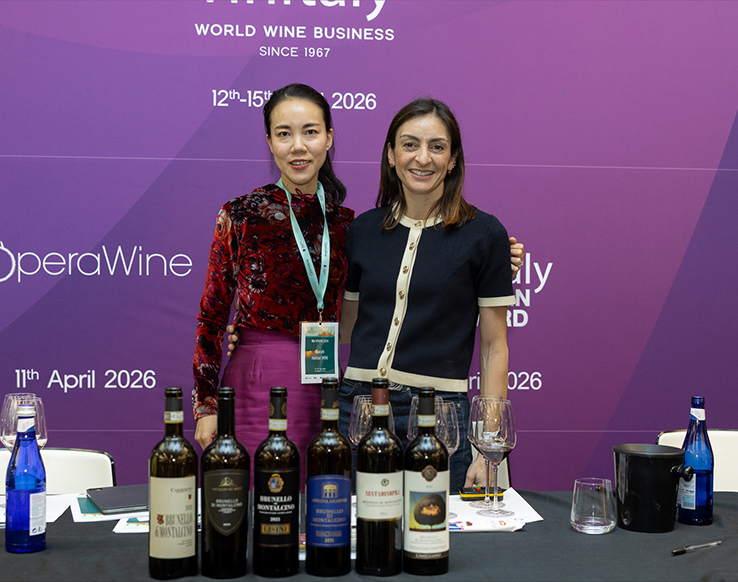
Brunello 2021: Decoding the Vintage
Carlotta Salvini, Head of Marketing and Communication for the Consorzio, presented the session. Her comprehensive knowledge of the territory and the wines gave her session a great sense of clarity. She described the area of the Montalcino DOCG with precision: in the northwest there are very few vineyards and lots of forest, in the northeast and southeast there are more fragmented and smaller vineyards, in the southwest there are more vineyards, bigger vineyards, and "bigger players".
Overall, the region has 4,400 ht of vineyards, in Val D'Orcia, of which 2,100 are Brunello DOCG. The area was designated a Unesco world heritage centre in 2004. The town of Montalcino sits at 564 meters above sea level, and altitude, slope, location, and soils are crucial to the expression of Sangiovese that ends up in our glasses.
Carlotta explained that the Consorzio has recently completed a project "decoding" the 2021 vintage. The wines were evaluated through two different lenses: analytical and sensory. Sarah Heller MW was part of the team that analysed the wines.
Before looking at the Brunello DOCG wines, Carlotta gave the students an update on the state of Rosso di Montalcino. The denomination now covers 860 hectares, two years ago it was only +/- 500. The expansion is not due to new plantings, it comes from non-DOC vineyards already in existence that have now become part of the Rosso di Montalcino denomination, producing an additional 1.5 million bottles now on top of the existing 4 million bottles per year. RdM is no longer a secondary wine, and it is an increasingly precise and intentional expression of Sangiovese.
Carlotta told us that the key point is the destination of fruit per appellation. She pointed out that Montalcino is producer driven. The producers must respect the limits on yield, and other rules of Consorzio; however, they can play with quality, they can declassify some grapes from Brunello in a bad year and make RdM instead. They cannot, however, do the opposite and classify RdM grapes as Brunello. The grapes are not linked to the plot itself, as is the case in Burgundy. The producer can decide each year how to use their grapes.
Looking at the geology and origin of Montalcino soils, Carlotta explained the importance of marine soils with marine deposits and alluvial sediments, both of which have sandy, clay, and conglomerate soils. The most crucial area is in the southwest. Monte Amiata in the southeast, mitigates weather, plays a big role. The southwest is more Mediterranean in climate, while the northwest is very cold.
The Consorzio has 219 wineries involved, over 27% are organic, all must use 100% Sangiovese. Brunello requires 2 years aging, released in 5th year after harvest, and so the 2021 is the vintage in the market now. Rosso di Montalcino has no restriction on aging and release.
Carlotta presented the “Brunello Forma”: the vintage evaluation model created specifically. Gabriele Gorelli MW and Andrea Lonardi MW now coordinate the tasting panel, of which Sarah Heller MW was a member.
The Forma project has created an environmental mosaic of Montalcino, putting data into words using weather stations and other technology to gather comprehensive information on every vintage. DATA, WINE, INTERPRETATION are the 3 pillars of the evaluation.
The 2021 vintage showed temperatures that were generally in line with the most recent 30-year average, no extremes of temperature were noted. It was a vintage that was significantly dry during key parts of the growing season, one of the driest since 2003. There was no rain in spring or autumn, but there was some spring frost on the northeast side. There was an early start of bud break, then spring frost, followed by a long dry summer, moderately warmer than 2020, but without long periods of heat waves. The vintage was marked by water stress rather than extreme temperatures. There was a very short harvest period
Following the panel tasting, a word cloud was created, with the following descriptors being among the most frequently used: ripe, sweet, juicy, citrus, cherry, well-balanced, spicy, savory.
The official definition of the Brunello di Montalcino DOCG 2021 vintage was: "Fragrant, Refined, Slender".
Carpineto Brunello di Montalcino DOCG 2021, on the NW side at 500 m asl, in a forested environment, aging in large oak for 3 yrs, mineral and floral, crunchy fruit, high acid, not overly generous, slender, herbal, iron, gentle, balanced, lots of sticky fine tannin.
Castiglion del Bosco Brunello di Montalcino DOCG 2021 is on the NW side at 350m asl with 2 years in French oak, fruitier nose, more volume on the palate, more black fruited berries, floral and spicy, clove, licorice, cigar tobacco finish, slightly more appealing tannins, rose hip tea.
Lisini Brunello di Montalcino DOCG 2021 is from an historic winery with an important reputation, on the south side, at 350-500m asl, with 36 months in Slavonian oak, it is a classic style, very savory nose, black cherried fruit, very austere, very harsh acidity and sharp fruit, firm tannin, black olive brine, needs time to blunt it all down, it is not round, not soft, very tight.
Abbadia Ardegna Brunello di Montalcino DOCG "Vigna Piaggia" 2021, is from a cru vineyard called Vigna Piaggia, on the NE side, with 24 months in Slavonian oak, fresher ripe red cherries, nose is attractive, saline, ripe red plum, some blood orange zest, beautifully managed acidity and tannin, pretty spices cinnamon stick, red licorice syrup, a bit of menthol, very fresh on the finish, excellent balance, generous, nice play of fruit and savoriness.
Sesta di Sopra Brunello di Montalcino DOCG 2021 in from the south side, a small artisanal estate of only 4 ht, with 3 years in Slavonian oak, very balsamic, ripe black and red cherry, ripe red plum, nutmeg, juniper berries, lots of tannin quite talc and sticky and pleasant, extracted, structured, needs some time to relax.
Camigliano Brunello di Montalcino DOCG 2021 is not from a single vineyard, on the SW side, 30 months in oak and cement and bottle, on top of a hill, warmer zone, very lovely fruit, orange and cherry and red currant, great acidity, generous, sweet spice, nutmeg, star anise, clove, citrusy mandarin peel on the finish, refined and elegant, soft sweet tannins, rounded and easier to drink now.
Sarah commented that the depth of layers in these wines is crucial to the profile of Brunello. These wines require time to be evaluated. The move towards site specificity has been very slow, due to a reluctance of producers to do this. Brunello di Montalcino is not like Barolo where the producers intentionally go for particular sites, although certain winemakers in Brunello definitely highlight the specific character of their site. Human choices are almost part of the terroir here. Montalcino has clusters of producer types: the historic area has very traditional winemakers and they do a classic style. The choice of extraction depends on the characteristics of the vintage and timing profile.
Carlotta explained that the aim of the project is to collect the data, collect a historical database to understand the territory. Crossing weather information with the growing stages of the vine is a new element to the data gathering. Building and creating a map of soil composition across the region is key to understanding. Digging into the vintage personality and how it was shaped during the growing season helps us to read a vintage in the glass. We must ask ourselves, why does this wine taste like this? The previous evaluation system was based on weather data from the season and an immediate tasting of very young wines, with a star rating system. Evaluation was extremely early, in the year after the harvest, when the wines were not finished. It was not a useful tool in the end, not good for communicating the wines. The shift was in understanding that the method was not helpful and possibly damaging. The change came in 2020, where the wines were rated unfinished, but then there was a second tasting and the finished wines were evaluated. This new form is a critical tool for communicating about a vintage and saying not how many stars it was, but what style it was and what its aging curve is likely to be. Gives us a new way to think about these wines.
Sarah and Carlotta agreed that more frequent unpredictable weather events are difficult to predict and adapt. The resistance of the vineyard is crucial to the future. This attention will also play a part in understanding site expression. Massal selection is very frequent now and Banfi has a sort of nursery of Sangiovese clones from this work. Biondi Santi used all genetic material to renovate their old vineyards with the Brunello Biondi Santi clones. The weather stations help the producers too; all the data is public and shared to all the producers in the region. Many are following sustainable approaches, even those who are not fully organic certified. Sarah closed by saying that Brunello is a conservative region but there are changes afoot!
Wines tasted:
1. CARPINETO: Brunello di Montalcino Docg 2021
2. CASTIGLION DEL BOSCO: Brunello di Montalcino Docg 2021
3. LISINI: Brunello di Montalcino Docg 2021
4. ABBADIA ARDENGA: Brunello di Montalcino Docg “Vigna Piaggia” 2021
5. SESTA DI SOPRA: Brunello di Montalcino Docg 2021
6. CAMIGLIANO: Brunello di Montalcino Docg “Paesaggio Inatteso” 2021