Blind tasting Pinot Noir vs. Nebbiolo – how to recognize the difference
Tasting notes and summary provided by Diane Heck, Italian Wine Ambassador.
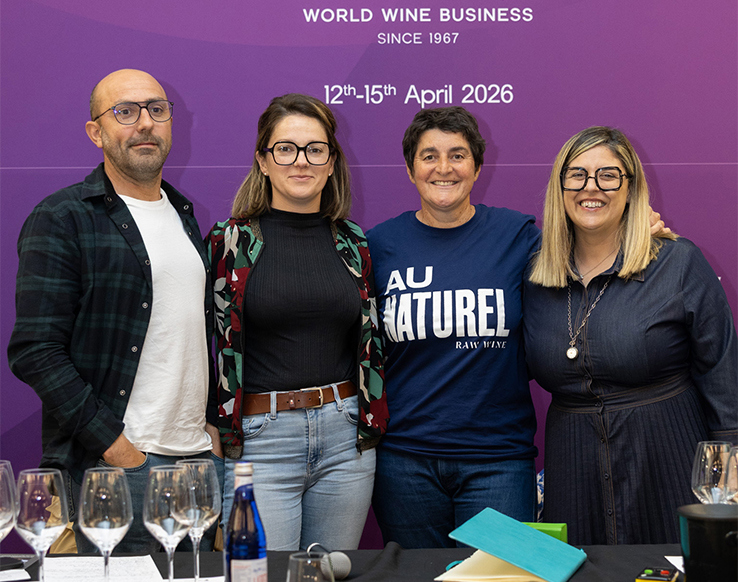
At Vinitaly 2026, Isabelle Legeron MW, founder of the seminal RAW WINE movement, led the tasting of six wines produced by two members of RAW WINE (a global community that promotes low-intervention, organic, and biodynamic wines).
Isabelle welcomed everyone and stressed that the focus for the producers of these wines was on purity in vinification and production. She encouraged the attendees to use all the clues – color, tannin, texture, propensity to age – when tasting these wines. Trust your instincts – often your first identification is correct!
Nadia Curto from Azienda Agricola Curto in Piedmont described La Morra and the growth in the number of producers. Typically, the wines from La Morra are more elegant than the other Barolo areas due to higher clay content that retains water more effectively.
Nadia’s property is four hectares and everything is done by hand, without chemicals. Nebbiolo is the most important grape and a little Dolcetto and Barbera are also planted. Nadia mentioned that the origin of the name Nebbiolo is connected to the fogs which are characteristic of harvest time. In Barolo, normally the place name is on the label rather than the grape name.
Nadia’s first vintage was in 1997. When she took over the vineyard from her father, she stopped using chemicals. The early vintages were for family consumption only. Nadia said that when you work in the natural way you have to learn by experimentation – traditional viticulture education only addresses traditional methods, so you learn as you go.
Anne-Lise Roman from Clos du Moulin aux Moines described her ancient estate, established by monks, in the heart of Cotes de Beaune. The cellars date back to the 15th century. The estate has 15 hectares of vineyards producing 20 appellations, mostly red, including Bourgogne, Auxey-Duresses and Pommard. Willy Roulendes is the administrator of the estate, and he explained that Clos du Moulin aux Moines follows the principles of biodynamics. With clay and limestone soils, both Pinot and Chardonnay grow well. Anne-Lise described the various theories on the origin of Pinot Noir.
The six wines were poured blind and a vote was taken after each tasting on whether the wine was a Nebbiolo or a Pinot Noir.
Surprise! After the first wine was tasted, by a show of hands, Isabelle noted that the attendees were split 50/50 – half judging the wine to be Nebbiolo and half convinced that the wine was Pinot Noir.
And so, it went with all five of the remaining wines, with each garnering about 50% for each grape.
The identities were revealed at the end:
Wine 1 – Nebbiolo – Nadia Curto, Langhe Nebbiolo Doc 2023
Wine 2 - Pinot Noir - Clos du Moulin aux Moines, Auxey-Duresses Clos du Moulin Aux Moines Monopole rouge 2023
Wine 3 - Pinot Noir - Clos du Moulin aux Moines, Pommard Premier Cru Clos Orgelot Monopole 2020
Wine 4 - Nebbiolo – Nadia Curto, Barolo Arborina Docg 2020
Wine 5 - Nebbiolo – Nadia Curto, Barolo Docg Foia 2011
Wine 6 - Pinot Noir - Clos du Moulin aux Moines, Pommard Premier Cru Clos Orgelot Monopole 2011
So… how do we explain the split vote? One clue might be that both producers adhere to the principles stressed by Isabelle at the start – purity in vinification and production. Allowing the character of the terroir and the fruit to shine brightest adds a character to these wines that renders them closer to siblings than distant cousins.
Another insightful masterclass at Vinitaly 2026.
Tasting notes and summary provided by Diane Heck, Italian Wine Ambassador.